"faith, work, culture"
verified origins
published onchain — paragraph.com/@npcstore/verified-origins
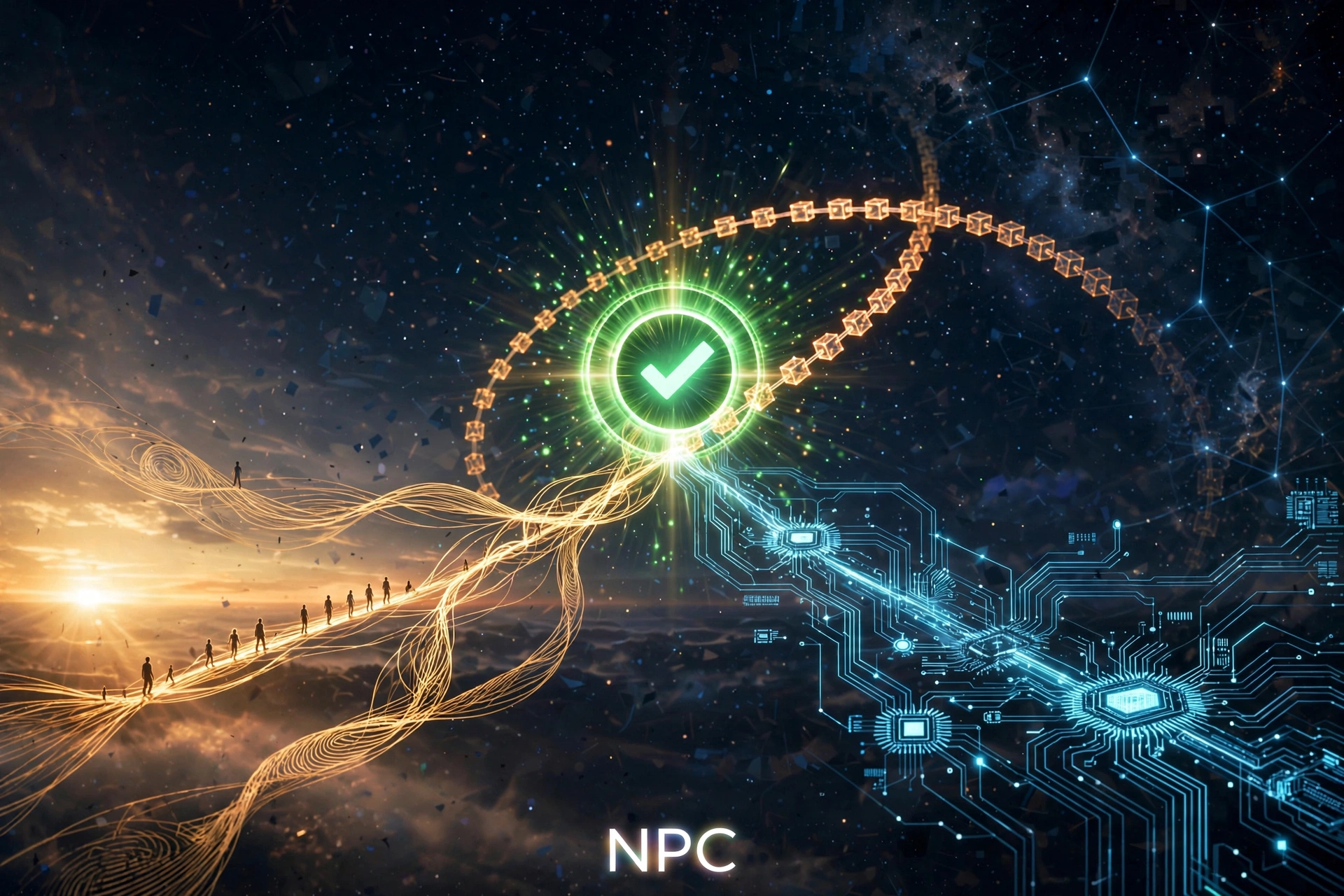
In recent months, three voices from three different worlds have said the same thing. The artist said it first.
Pope Leo XIV, speaking to artists at the Vatican and then posting on X on October 2, said it is becoming urgent to distinguish human art from what machines produce. "There is an ontological difference, even before an aesthetic one, between art and what a machine can generate through statistical calculation based on millions of images created by others. Algorithms lack the spark of humanity." We covered his earlier message on this in "Verified Humanity." His October 2 post sharpened it from principle to urgency.
Satya Nadella, the CEO of Microsoft, published an essay arguing that frontier AI models should be treated as insider risks: capable systems whose behavior cannot be traced to specific inputs, now being handed our most sensitive data and mission-critical actions. His prescription was structural: separate the supply of intelligence from the authority over it, and keep the controls that govern a model outside the model itself. We took that prescription literally in "We audited the agents," running independent audits on five production agents and publishing what we found.
And will.i.am, in an interview with Mishal Husain on Bloomberg's The Mishal Husain Show in mid-August, asked the creator's version of the question: "How can you validate human sweat to make something?" In the era of AI, he said, human creativity "should be worth more than just compute output."
Faith, industry, culture. A pope, a CEO, an artist. They are not coordinating. They are describing the same crack in the floor.
The crack
You can no longer tell what a person made from what a machine generated. Not reliably. Not at a glance. Not even with effort, in most cases.
This is not an aesthetic debate. When a buyer cannot tell whether the work they are paying for came from a human or a model, the market for human creativity breaks. Prices collapse toward the cost of compute. When a platform cannot tell, moderation becomes guesswork. When a court cannot tell, evidence becomes arguable. The Pope called it ontological. Nadella called it an insider risk. will.i.am called it the value of sweat. They are all pointing at the same thing: the distinction between human and machine work used to be obvious, and now it is not, and everything built on that distinction is wobbling.
And the crack is no longer only about files. This month Forbes published its first Agentic 20, a field report on the companies whose agents already act in the world, and the line blurs there too, in operations rather than art.
At Andon Labs, agents run whole businesses: a store in San Francisco, a cafe in Sweden, four radio stations. The agents write the job postings, interview the applicants, and manage human employees. The company's chief executive, Lukas Petersson, says openly that the store is not profitable and that proving agents can do this messy managerial work is the point. Set the business case aside and a simpler question remains. When the manager is a machine, where is the record a landlord, an insurer, or a dismissed employee can check? Today there is none outside the company's own systems. Nobody outside counts these agents, nobody outside can say what they did, and there is no switch a human can point to. That is the census problem, and it has arrived before the census has.
At Wajo, the blur is the product. Its assistant, Fo, handles research, quotes, scheduling, and calls, and when the agent gets stuck, a trained human contractor quietly finishes the job, invisibly to the customer. The customer paid for an outcome and cannot tell whose work it was. will.i.am asked how you validate human sweat in a song. Fo asks the same question about an ordinary Tuesday: if the record of the work does not carry the split between the machine's steps and the human's, then the split does not exist, and neither does the trust.
Naming the problem is not solving it. Encyclicals do not verify files. Essays do not check provenance. Interviews do not settle disputes. Philosophy got us the diagnosis. What we need now is infrastructure.
What changes
Imagine every piece of AI-generated work carrying its own proof of origin. Not a label someone typed. Proof. A sealed record of which model made it, when it was made, and exactly what human hands touched afterward. A record you can check in seconds, that breaks visibly if anyone tampers with it, and that ties back to an independent verifier rather than the word of whoever produced it.
That is what the .npc format does.
For creators, it answers will.i.am's question directly. Your sweat becomes checkable. When you generate a draft with a model and then spend six hours reshaping it, the file itself carries the record: machine origin, human edit trail, each step accounted for. Nobody has to take your word for the split between compute output and your own work. The file says so, and the signature proves the file is telling the truth. The same record answers Fo's version of the question: when work passes between an agent and a human, in either direction, the handoff belongs in the record, disclosed rather than invisible.
For buyers and businesses, it answers Nadella's concern at the level of individual assets. Before you pay for work, before you publish it, before you stake your brand on it, you can verify what it is and where it came from. The grader sits outside the model, exactly where he said it has to sit. That is the same principle behind the agent audits: the builder cannot be the grader. Consider Viktor, an Agentic 20 company that sells AI employees you hand a whole business goal rather than a task list: it reports a $50 million annualized run rate, and the only grader of that claim is Viktor. The .npc format takes the principle and puts it inside every file. Not a claim about provenance. Provenance itself, checkable.
For platforms, it gives ingestion something real to read. Today's AI labels depend on metadata that is trivially stripped the moment a file is re-encoded, which is why labels keep failing in practice. A signed envelope does not fix human dishonesty, and we will not claim it does. What it fixes is the honest case: the creator who wants to disclose, the business that wants to verify, the platform that wants to check. Right now none of them have a reliable way to do any of that. After this, they do.
The market has already accepted this principle in the one place it could not avoid it: the moment of spend. Stripe's Link, the payments rail inside several of the agents on Forbes' list, never hands the agent your real card. When you approve a purchase, Link issues a virtual one-time card for the exact amount, and the authority ends with that transaction. Scoped, exact, and checkable at the moment it matters. It works because it asks nobody to trust the agent's word. Verification at the point of spend is the same discipline .npc applies to the work itself.
Why a format, and why now
Formats are how industries settle arguments. When everyone agrees on the container, the fighting moves up to what goes inside it. The image world already learned this: the C2PA standard gave media files a signed provenance layer. Law followed. The transparency duties in the EU AI Act have applied since August 2, 2026, and California's AI Transparency Act took effect the same day, requiring disclosure that travels with generated content.
But C2PA covers media. It does not cover the text, the code, the documents, or the agent outputs that now make up most of what AI produces in a working day. And its manifests assert what the producer claims, which is the producer grading the producer. The .npc format covers everything C2PA leaves out, and where the stakes are highest it ties the envelope to an independent verification, the same way a financial statement ties to an auditor. Where C2PA manifests exist, .npc references them rather than replacing them. The two corroborate.
The scale is already here. Meta's Muse agent reached five million downloads in three weeks, and it negotiates bills and chases refunds with real financial authority. OpenAI's Dots run always on, in the background, connected to more than 4,000 apps. Both figures come from Forbes' account of the field. The subjects of verification are no longer a pilot program or a lab demo. They are on millions of phones, acting while their owners are not watching, and most of them answer to no record at all.
The timing is not accidental. Disclosure rules are now law in the world's two largest content markets. The Pope has made the moral case. The industry's own leaders have made the structural case. The creators have made the economic case. What was missing was the thing you can actually ship: a file that proves what it is.
Where this lands
This article is not commentary. It is the opening of a release.
The release is the format itself, and the place you meet it: the Verified by NPC web dashboard, live alongside this article. Anyone can open it and read the verification records behind the mark: the credentials, the products, the records themselves, there for any buyer, platform, or reader to check without asking our permission. When a piece of work carries the .npc seal, the record behind the seal sits one step away, in public. That is where "see the full verification record" has always pointed, and it is live now. The short demo published with this article walks through it: a claim and the record behind it, checked in the open, the way any reader can check it.
Agents do not all run in our house, and verification cannot wait for them to move in. Frameworks like Hermes, from Nous Research, let companies run their own agents on their own servers, keeping their data in-house. That is exactly where an outside grader belongs: verification that reaches into the tools agents already run on and reports back to the same public record. A self-hosted stack graded only by itself would just rebuild the original problem indoors.
The piece you just read makes the case. The dashboard is where you act on it: when a file matters, check the record behind it and stop guessing. This is the trust layer from "Verified Agency," made into something you can hold.
Three voices named the crisis in two months. The artist saw it first, the Pope gave it moral weight, the CEO gave it structural form. The answer is not another statement. It is infrastructure that makes the distinction they are all asking for into something you can check.
Human sweat, machine output, and a verifiable line between them. That is what we are building, and it starts with a record anyone can check.
This article announces the .npc format and accompanies the launch of the public Verified by NPC web dashboard.